Do you want BuboFlash to help you learning these things? Or do you want to add or correct something? Click here to log in or create user.
Subject 4. Consumer Equilibrium: Maximizing Utility Subject to the Budget Constraint
#cfa #cfa-level-1 #economics #has-images #microeconomics #reading-14-demand-and-supply-analysis-consumer-demand #subject-4-consumer-equilibrium-maximizing-utility-subject-to-the-budget-contraint
The budget constraint line separates consumption bundles that are attainable from those that are unattainable. A consumer will maximise utility by consuming on the highest possible indifference curve (i.e., we assume all income is spent). This is where an indifference curve is tangent to the highest possible budget line.
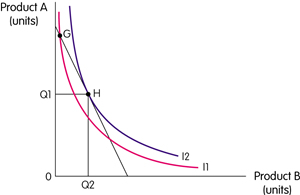
A consumer could consume at G, for example, but would be on a higher indifference curve at H. This means that to maximise utility the consumer would consume Q1 of product A and Q2 of product B.
The consumer is maximising utility where the budget line and indifference curve are tangent, i.e., MUB/MUA = PB/PA.
An Increase in Income
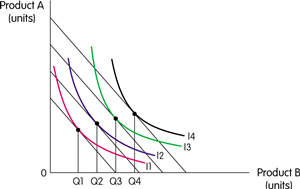
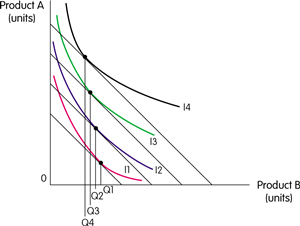
An increase in income shifts the budget line out parallel. The new combinations of products that maximise utility can be identified.
If this is a normal good, an increase in income increases the quantity demanded.
Inferior goods have a negative income elasticity of demand. Demand falls as income rises.
If you want to change selection, open original toplevel document below and click on "Move attachment"
Summary
| status | not read | reprioritisations | ||
|---|---|---|---|---|
| last reprioritisation on | suggested re-reading day | |||
| started reading on | finished reading on |
Details
Discussion
Do you want to join discussion? Click here to log in or create user.