Edited, memorised or added to reading queue
on 11-Jul-2014 (Fri)
Do you want BuboFlash to help you learning these things? Click here to log in or create user.
| status | not read | reprioritisations | ||
|---|---|---|---|---|
| last reprioritisation on | suggested re-reading day | |||
| started reading on | finished reading on |
Bond duration - Wikipedia, the free encyclopedia
ge point change in yield per year (for example yield going from 8% per year (y = 0.08) to 9% per year (y = 0.09)). This will give modified duration close to the value of Macaulay duration (and the same when rates are continuously compounded). <span>Formally, modified duration is a semi-elasticity, the percent change in price for a unit change in yield, rather than an elasticity, which is a percentage change in output for a percentage change in input. Modified duration is a rate of change, the percent change in price per change in yield. In derivatives pricing ("The Greeks"), the closest analogous quantity is Rho, which is the price elasticity (percentage change in price for percentage change in interest rate),
Flashcard 149625138
| status | not learned | measured difficulty | 37% [default] | last interval [days] | |||
|---|---|---|---|---|---|---|---|
| repetition number in this series | 0 | memorised on | scheduled repetition | ||||
| scheduled repetition interval | last repetition |
Parent (intermediate) annotation
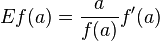
Open itad><head>In mathematics, the elasticity or point elasticity of a positive differentiable function f of a positive variable (positive input, positive output)[1] at point a is defined as[2] using functions and their derivatives meaning in words: It is thus the ratio of the relative (percentage) change in the function's output \(f(a)\) with respect to the relative change in its input \(a\), for infinitesimal chan
Original toplevel document
Elasticity of a function - Wikipedia, the free encyclopediaer:filter:minify-css:7:3904d24a08aa08f6a68dc338f9be277e */ Elasticity of a function From Wikipedia, the free encyclopedia Jump to: navigation, search <span>In mathematics, the elasticity or point elasticity of a positive differentiable function f of a positive variable (positive input, positive output)[1] at point a is defined as[2] or equivalently It is thus the ratio of the relative (percentage) change in the function's output with respect to the relative change in its input , for infinitesimal changes from a point . Equivalently, it is the ratio of the infinitesimal change of the logarithm of a function with respect to the infinitesimal change of the logarithm of the argument. The elasticity of a function is a constant if and only if the function has the form for a constant . The elasticity at a point is the limit of the arc elasticity between two points as
| status | not read | reprioritisations | ||
|---|---|---|---|---|
| last reprioritisation on | suggested re-reading day | |||
| started reading on | finished reading on |
Overnight indexed swap - Wikipedia, the free encyclopedia
ader:filter:minify-css:7:3904d24a08aa08f6a68dc338f9be277e */ Overnight indexed swap From Wikipedia, the free encyclopedia Jump to: navigation, search <span>An overnight indexed swap (OIS) is an interest rate swap where the periodic floating rate of the swap is equal to the geometric average of an overnight rate (or overnight index rate) over every day of the payment period. The index rate is typically the rate for overnight unsecured lending between banks, for example the Federal funds rate for US dollars, Eonia for Euros or Sonia for sterling. The fixed ra