Edited, memorised or added to reading queue
on 18-Aug-2018 (Sat)
Do you want BuboFlash to help you learning these things? Click here to log in or create user.
Flashcard 149625149
 .
.
| status | not learned | measured difficulty | 37% [default] | last interval [days] | |||
|---|---|---|---|---|---|---|---|
| repetition number in this series | 0 | memorised on | scheduled repetition | ||||
| scheduled repetition interval | last repetition |
Parent (intermediate) annotation
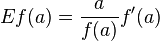
Open itthe elasticity or point elasticity of a positive differentiable function f of a positive variable (positive input, positive output)[1] at point a is defined as[2] using functions and their derivatives meaning in words: <span>It is thus the ratio of the relative (percentage) change in the function's output \(f(a)\) with respect to the relative change in its input \(a\), for infinitesimal changes from a point . <span><body><html>
Original toplevel document
Elasticity of a function - Wikipedia, the free encyclopediaer:filter:minify-css:7:3904d24a08aa08f6a68dc338f9be277e */ Elasticity of a function From Wikipedia, the free encyclopedia Jump to: navigation, search <span>In mathematics, the elasticity or point elasticity of a positive differentiable function f of a positive variable (positive input, positive output)[1] at point a is defined as[2] or equivalently It is thus the ratio of the relative (percentage) change in the function's output with respect to the relative change in its input , for infinitesimal changes from a point . Equivalently, it is the ratio of the infinitesimal change of the logarithm of a function with respect to the infinitesimal change of the logarithm of the argument. The elasticity of a function is a constant if and only if the function has the form for a constant . The elasticity at a point is the limit of the arc elasticity between two points as